Florida Fish and Wildlife Conservation Comm:
Coral Springs Humane Officers (Coral Springs only):
South Florida Wildlife Care Center (Ft. Lauderdale):
Duck Haven: Muscovy ducks only (Margate):
Pelican Seabird Station (Miami):
The Conservancy of Southwest Florida (Naples):
Busch Wildlife Sanctuary (Jupiter):
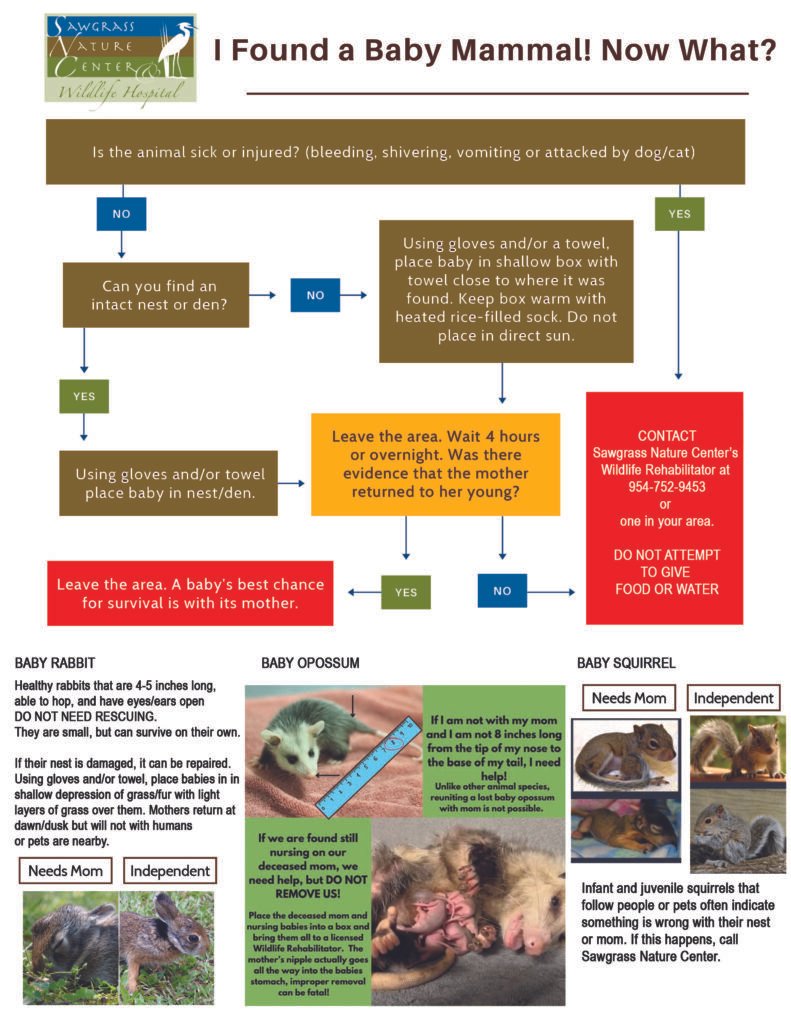
Humans are a young wild animal’s last hope for survival — not its best hope. A young animal should only be removed from the wild after all efforts to reunite it with its parents have been explored.
Observe from a distance first. Most young animals are being monitored and cared for by their parents, even if you do not see them.
An orphan is a young animal that:
It is natural for young wildlife to explore alone once they leave the nest.
If the animal is:
It likely does not need help. Watch from a safe distance before taking action.
Young wild animals often need protection — not removal.
Common dangers include:
Keep pets and children away while assessing the situation. Some wildlife may carry diseases, so avoid direct handling.
If the animal is cold to the touch (especially nestlings), weak, or lethargic, it may need assistance.
If the animal is near a roadway, move it to a safer nearby location only if it can be done safely. Never endanger yourself or others.
If the animal appears:
It should be taken to a licensed wildlife rehabilitation facility.
If a cat or dog has attacked the animal, assume it is injured — even if there are no visible wounds. Pet attacks frequently cause serious internal injuries.
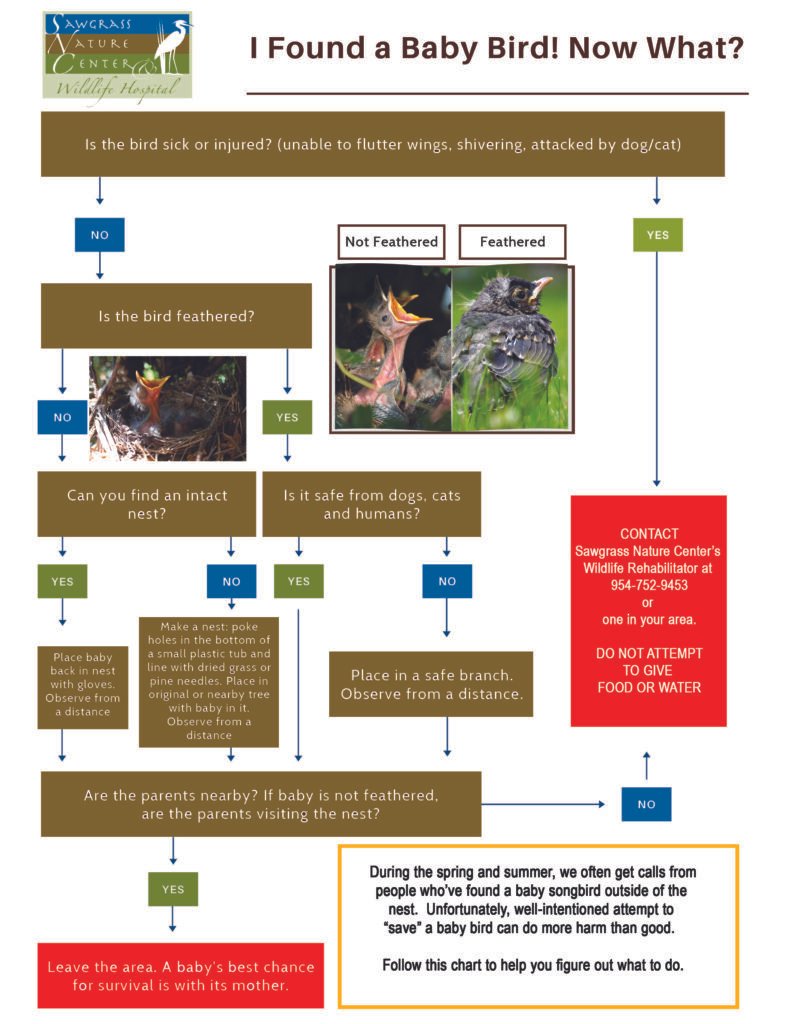
Nestlings (little or no feathers, cannot perch):
These birds should be returned to their nest whenever possible. If the original nest is destroyed, a temporary nest may be constructed nearby. Contact a wildlife rehabilitation facility for guidance.
Fledglings (fully feathered, able to hop or perch):
Fledglings naturally leave the nest and spend time on the ground. If needed, gently place the bird on a nearby branch out of reach of pets and observe from a distance to ensure parents return.
Ducklings are commonly separated while following their parents to food or water.
Look for nearby ponds or canals and attempt to reunite the duckling with its mother. A mother duck may accept a duckling of similar age, but do not chase waterfowl into traffic or put yourself in danger.
No. We do not admit Muscovy ducks because they are non-native. Please contact local resources for assistance.
Mother squirrels and raccoons frequently retrieve their young if they fall from the nest. They also maintain alternate nest sites.
Give the mother plenty of time to return before intervening.
Baby opossums require different responses depending on their size and condition.
First: Determine the Size
A baby opossum that is:
Is typically old enough to survive on its own and does not need assistance.
If the opossum is:
It likely needs help.
Opossums are marsupials, meaning their young develop in a pouch.
If a female opossum has been hit by a vehicle (especially in spring or summer), there may be live babies in her pouch that need rescue. Contact a licensed wildlife rehabilitation facility immediately.
Mother rabbits feed their young only at night. You will not see her at the nest during the day.
Rabbits leave the nest at approximately three weeks old.
If the rabbit:
It is independent and does not need assistance.
If you are uncertain whether a wild animal needs help, contact a licensed wildlife rehabilitation facility before intervening.
Observation is often the best first step — and gives wildlife the greatest chance of survival.